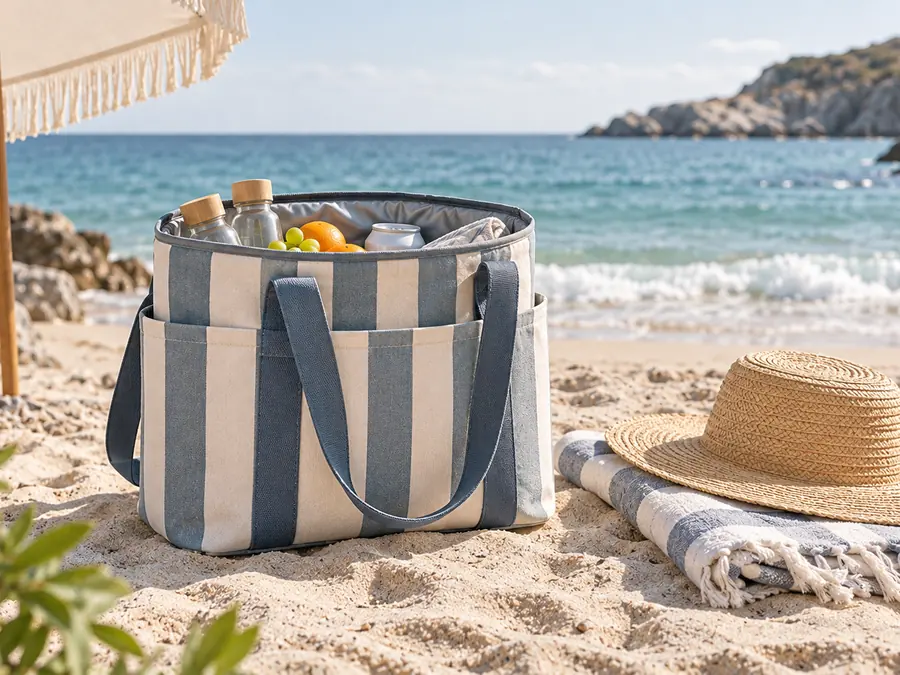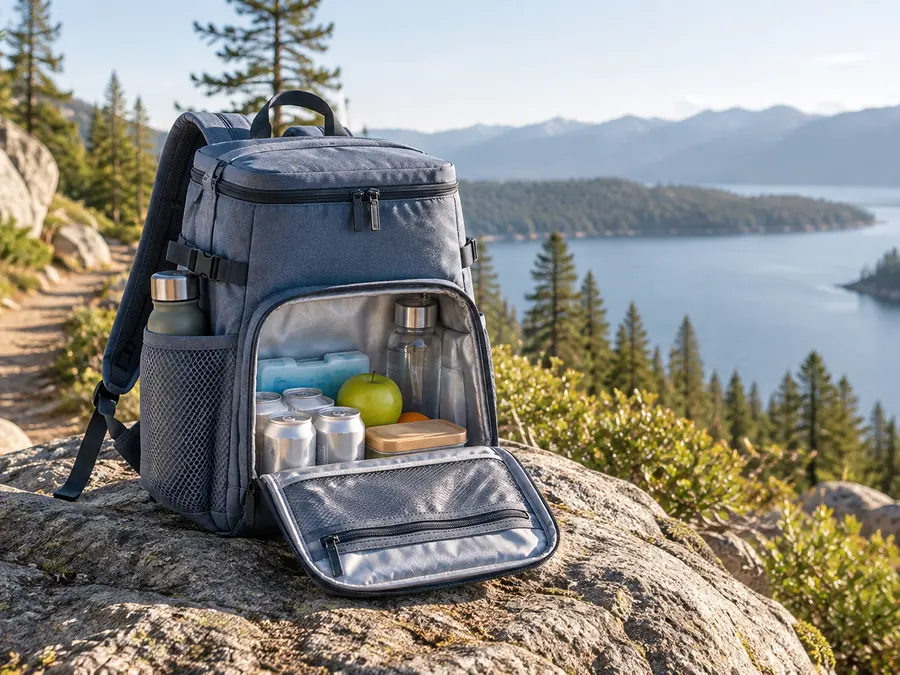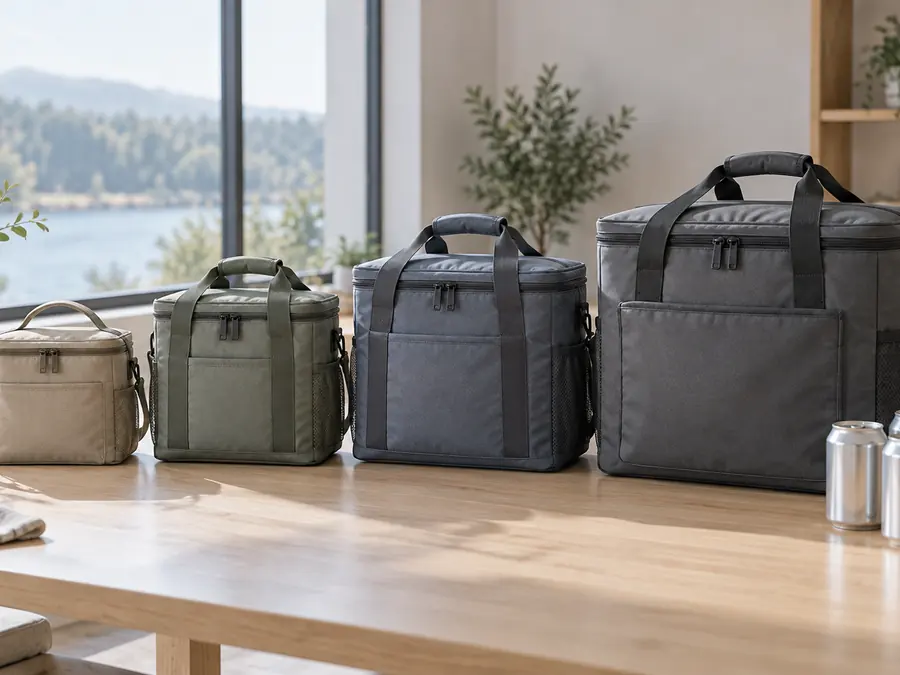
A soft cooler's performance comes from four things, in order of impact: closed-cell foam thickness (8–20 mm EPE), whether the liner is welded or stitched, the liner material itself (TPU > PEVA > foil-laminated film), and the closure. A typical 10 mm EPE wall with a welded PEVA liner and two 200 g gel packs holds refrigerated food under 8 °C for roughly 6–8 hours at 25 °C ambient. Doubling the foam to 20 mm buys you about 3–4 more hours; switching foil to TPU buys durability and food-contact compliance rather than hours.
Buyers ask us for "a cooler bag that keeps things cold for 12 hours" far more often than they ask for a specific construction. The problem is that cold-hold time is an outcome of four separate decisions, and a factory that says yes to the 12-hour number without changing any of them is telling you what you want to hear.
This guide is the internal logic we use when quoting an insulated bag, written out so you can brief any supplier — us or someone else — in terms that produce comparable quotes.
The four things that actually matter
1. Foam thickness (the biggest lever)
Almost all soft coolers use EPE — expanded polyethylene, a closed-cell foam sheet. Closed-cell matters: open-cell foam absorbs water and stops insulating the first time somebody spills a drink.
| Foam wall | Typical use | Cold-hold, 2 gel packs, 25 °C ambient |
|---|---|---|
| 5 mm | Promotional pouch, wine sleeve | 2–3 h |
| 8 mm | Lunch bag, small tote cooler | 4–6 h |
| 10 mm | Day cooler, picnic backpack | 6–8 h |
| 15 mm | Camping / fishing cooler | 10–14 h |
| 20 mm | Overnight cooler, delivery box | 16–24 h |
Those figures assume the bag is filled, closed and not opened. An empty cooler with one gel pack rattling around at the bottom performs far worse, because you are cooling air. Fill volume is part of the spec — tell your customers to pack it full.
2. Welded versus stitched liner
A stitched liner has needle holes in it. Every hole is both a leak path and a thermal bridge. A high-frequency welded liner is a sealed bladder dropped into the outer shell; it holds melt water, it can be wiped out, and it does not wick.
Welding adds roughly 8–15% to the bag cost and requires the liner film to be weldable — which foil laminate generally is not. If the end user will ever put loose ice in the bag, welding is not optional.
3. Liner material
- PEVA — polyethylene vinyl acetate. PVC-free, weldable, soft, cheap. The default for retail lunch bags and picnic coolers. Can be printed. Becomes stiff below about −5 °C.
- TPU — thermoplastic polyurethane. Two to three times the price of PEVA, far better abrasion and puncture resistance, stays flexible when cold, welds beautifully, and passes food-contact testing readily. Used on food delivery bags, premium coolers, medical cold chain.
- Aluminium-foil laminated film — a metallised film bonded to a scrim. Cheapest, reflects radiant heat, but creases whiten and eventually split, and it cannot form a reliable welded bladder.
- PU-coated polyester — used as a liner on some fashion-led lunch bags. Looks good, insulates through the foam behind it, but is not leak-proof.
If you are shipping into the EU or California, ask for the liner to be tested rather than described. A REACH SVHC screen and a food-contact migration test on the actual production liner costs a few hundred dollars and settles the argument permanently.
4. The closure
Heat gets in through the opening more than through the walls. In rough order of performance:
- Roll-top with a buckle — best, because it seals against itself.
- Zip with an insulated storm flap over it.
- Plain zip.
- Velcro or magnetic flap — convenient, leaks cold badly.
A zip that runs across the top of a bag exposes a long, uninsulated line. On 15 mm and 20 mm builds we usually specify a storm flap; it costs very little and it is the difference between a spec sheet number and a real one.
What we test, and what we will not claim
We can run a timed temperature test on your approved sample: thermocouple inside, logger running, gel packs weighed, ambient held at 25 °C, bag closed. You get the log as a chart, and the number on it is the number we will print on your packaging.
What we will not do is copy a competitor's "keeps cold 24 hours" claim onto a bag that has 8 mm of foam. Retail buyers in the UK, Germany and Australia increasingly ask for the substantiation behind that kind of claim, and the person holding the invoice is the importer, not the factory.
Cost consequences, honestly
Going from a foil liner to a welded PEVA bladder on a mid-size lunch bag adds roughly USD 0.35–0.60 per piece at 3,000 pcs. Going from PEVA to TPU adds roughly another USD 0.70–1.20. Going from 8 mm to 15 mm foam adds around USD 0.40 in material but can add more than that in freight, because the folded bag gets thicker and fewer fit in a carton.
The cheapest genuine improvement is almost always the storm flap and a better zip, not thicker foam.
A construction that works for most retail programmes
- 600D PU-coated polyester outer, or RPET 600D where you need a recycled-content claim
- 10 mm EPE foam
- Welded PEVA liner, white, wipe-clean
- Nylon coil zip, size 5, with a 25 mm storm flap
- Webbing handles bar-tacked at four points, adjustable shoulder strap with a 38 mm buckle
- Reinforced base panel, EVA insert optional
That bill of materials lands in the USD 3.20–5.80 FOB range depending on size, print and quantity, and it is honest about 6–8 hours.
Where to go next
If you know the construction you want, send it to us with your quantity and we will quote it line by line. If you are still deciding, browse the insulated lunch bag range and the picnic and outdoor coolers — every model listed there already exists as a tooled pattern, which shortens development by two to three weeks.
Frequently asked
Is PEVA or TPU better for a cooler bag liner?
TPU is tougher, stays flexible in cold, and welds into a genuinely leak-proof bladder, which is why it is used on premium and food-delivery bags. PEVA is cheaper, adequate for lunch bags and picnic coolers, and is what most retail programmes use. Both are PVC-free. Choose TPU when the bag will carry ice water or raw protein, PEVA when it carries packed lunches.
How thick should the insulation be?
8 mm EPE for a lunch bag, 10 mm for a day cooler, 15–20 mm for picnic and camping coolers that need to hold overnight. Thicker foam adds carton volume and freight cost, so the trade is usually decided by how many units fit in a 40 HQ container, not by the foam price.
Do aluminium-foil liners work?
Foil-faced film reflects radiant heat and is the cheapest liner, but it creases, tears at the folds and cannot be welded into a watertight bladder. It is fine for promotional giveaways and low-price grocery coolers. It is a poor choice for anything the end user will wash or fill with ice.