An eco-friendly lunch bag or sustainable tote bag is one built from a lower-impact material — usually RPET, organic or recycled cotton, or cork — and made to be used for years. The material only counts if it is documented: a GRS transaction certificate for recycled content, an organic certificate for organic cotton. Durability and a precise, provable claim matter more than a green colour.
“Eco-friendly” is the most requested and least defined word in our briefs. Buyers want sustainable tote bags and eco-friendly lunch bags because their customers ask for them, but a bag only earns the label if two things are true: the material choice genuinely lowers impact, and the claim on the swing tag can be proved with paperwork. This guide walks through the materials we are asked about most — RPET, organic and recycled cotton, cork, and the liners inside insulated bags — and the documents that turn a material into a claim you can print.
What makes a lunch bag or tote bag eco-friendly?
A lunch bag or tote is environmentally friendly when it replaces many disposable bags over a long life, uses a lower-impact or recycled material, and carries a claim that is specific and verifiable. Longevity is the part most often forgotten.
A reusable bag only beats a disposable one after it has been used many times, because making any durable bag costs more material and energy than making a single-use one. That means stitching, handle attachment and zip quality are environmental features, not just quality features. A recycled tote bag whose handle tears in a month is worse for the planet than a well-made virgin polyester one used for five years.
The second rule is precision. Advertising regulators in the UK, EU and US have all issued guidance against vague environmental claims. “Eco bag” on a tag says nothing; “Outer fabric made from 100% recycled polyester”, backed by a certificate, says something you can defend.
Eco-friendly bag materials compared
The four materials below cover almost every eco lunch bag and eco tote we are asked to quote. Each has a different strength, cost profile and proof document.
| Material | What it is | Strengths | Watch-outs | Proof for the claim |
|---|---|---|---|---|
| RPET 600D | Polyester spun from recycled post-consumer bottles | Same performance as virgin 600D; prints and coats well | Typically 8–15% more than virgin 600D; pale shades dye less evenly | GRS transaction certificate for the order |
| Organic cotton canvas | Cotton grown to an organic farming standard | Natural hand feel, takes print and embroidery, strong consumer appeal | Heavier, so more freight; not water resistant unless coated | Organic content certificate covering the supply chain |
| Recycled cotton | Cotton fibre recovered from cutting waste or textiles, often blended | Reuses existing fibre; good for recycled canvas tote bags | Shorter fibres, so usually blended for strength; colour range is narrower | Recycled content certificate, such as a GRS transaction certificate |
| Cork leather | Thin cork sheet bonded to a fabric backing | Distinctive, light, water resistant, premium look | Higher cost; the backing fabric is part of the material story | Material specification and test reports for the market |
For a deeper look at weights and coatings, including how RPET compares with 600D, 1680D and non-woven, see our bag fabric guide.
RPET: the default recycled polyester for lunch bags and totes
RPET is usually the most practical way to make a recycled lunch bag or recycled polyester tote bag, because it behaves like the virgin fabric it replaces. Chemically it is the same polymer, so it takes the same PU coating, the same prints and the same sewing settings.
The cost uplift is modest — RPET 600D typically costs 8–15% more than virgin 600D — and it applies to the fabric line, not the whole bag. On an insulated lunch bag, where foam, liner, zip and labour make up much of the price, the effect on the unit price is smaller than the fabric percentage suggests.
What makes RPET claimable is the GRS (Global Recycled Standard) transaction certificate that follows the specific order. Without it, a retailer’s compliance team cannot accept the claim, whatever the fabric invoice says. Ask for it at quotation stage, because it affects which mill the fabric comes from.
Organic cotton and recycled cotton tote bags
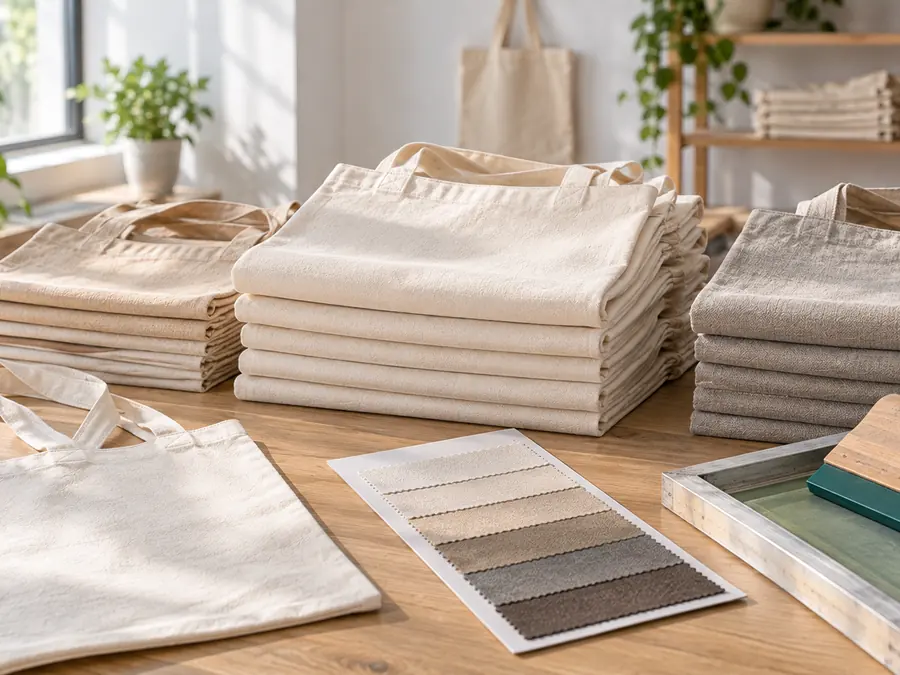
Cotton is the material most shoppers picture when they think of an eco friendly tote bag, and it suits both organic cotton tote bags and recycled cotton totes. It prints well, embroiders cleanly and has a natural look that customers associate with reuse.
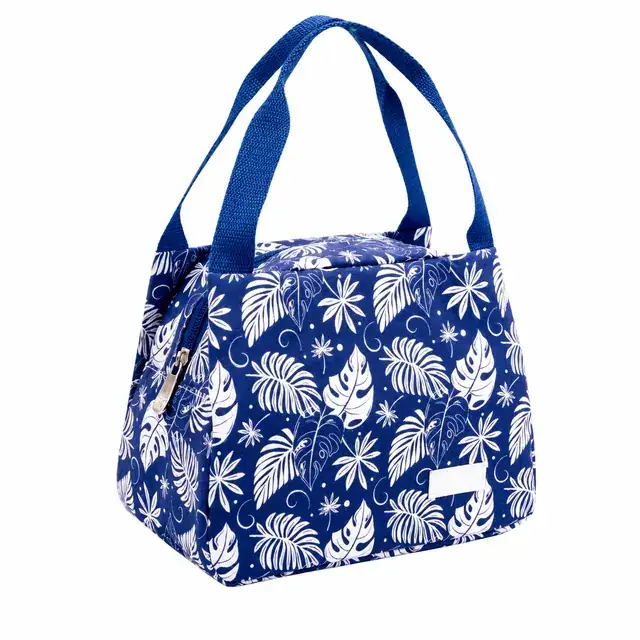
Two practical points matter. First, cotton is heavier than polyester at the same strength, so carton weight and freight cost rise. Second, untreated canvas absorbs water; a lunch bag in plain canvas needs an insulated, wipe-clean liner inside it. Our floral canvas insulated lunch bag (23.5×13×17.5 cm) shows the construction: a canvas outer for look and feel, an insulated lining for function.
Plain canvas tote bags are not a catalogue line for us; we build them to brief. If you are planning a cotton or recycled canvas tote programme, send a drawing or reference sample and we will quote the pattern.
Cork: a natural alternative for lunch bags
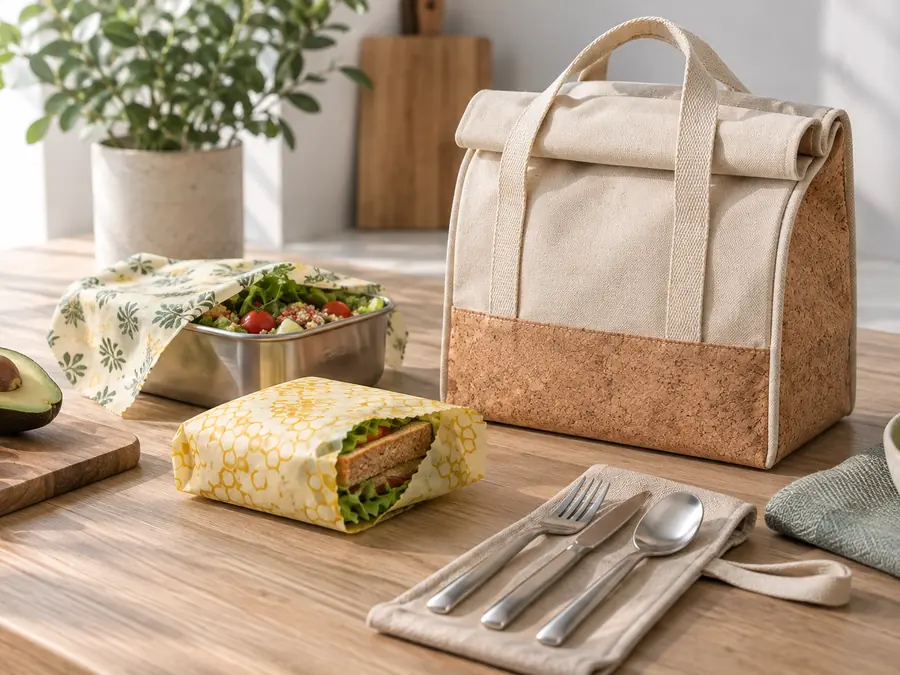
Cork leather is a thin layer of cork bonded to a textile backing. It is light, naturally water resistant and wipes clean, which makes it a good fit for a lunch bag that should look premium and feel natural.
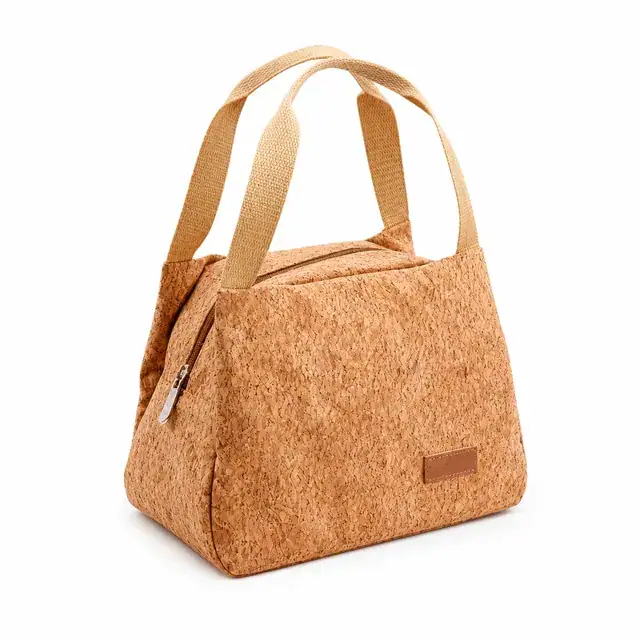
Cork suits smaller formats where its texture is the selling point. Our natural cork insulated lunch bag (23.5×13×17.5 cm) is a working example. When writing the claim, describe the cork outer accurately and remember that the backing fabric, insulation and liner are part of the bag too.
Liners and insulation: the hidden part of a sustainable lunch bag
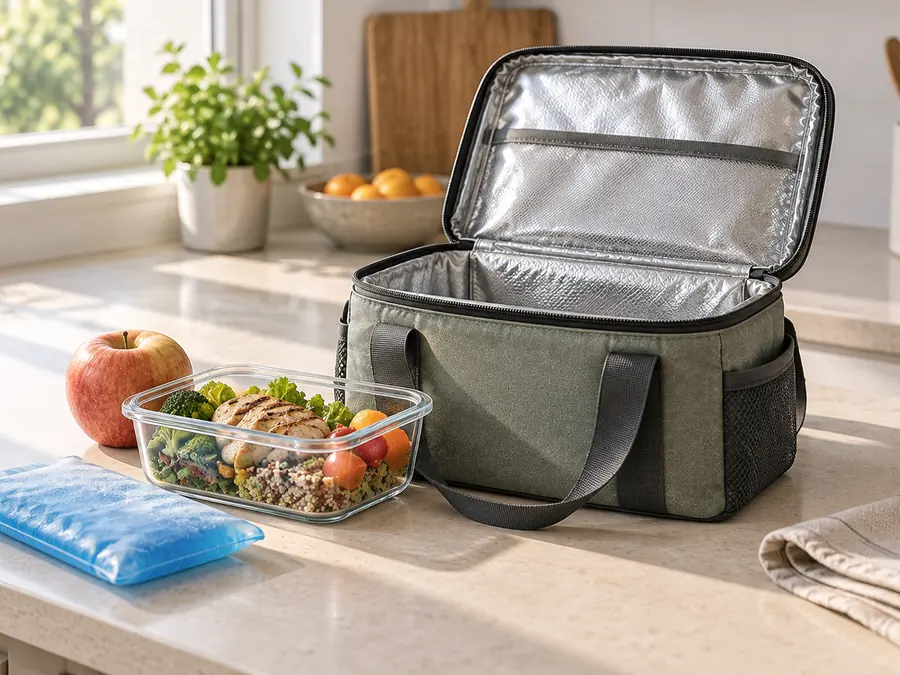
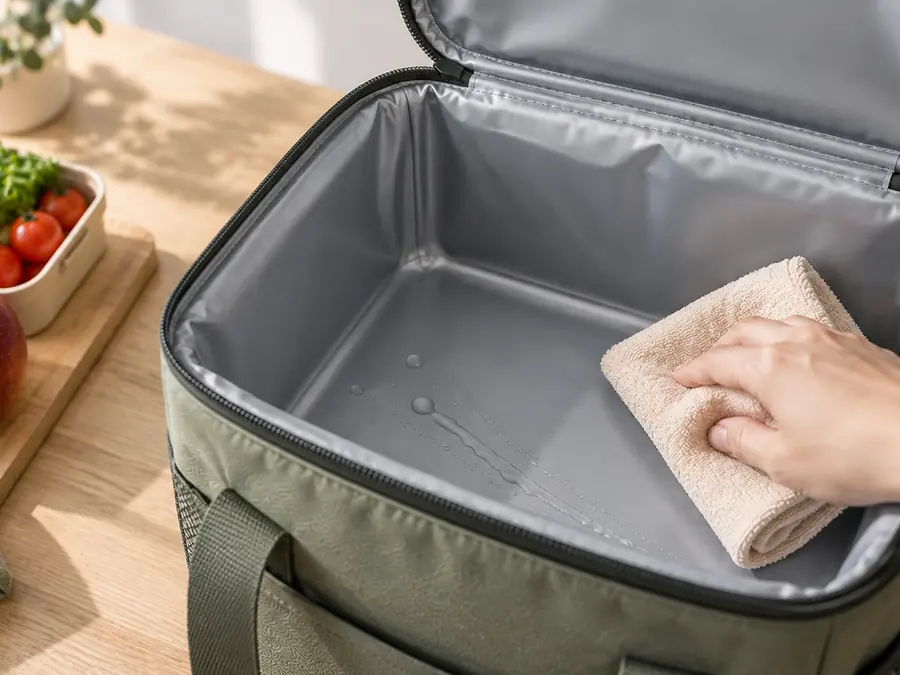
The liner is where most eco lunch bags quietly compromise, because the liner has to be food-safe, wipe-clean and leak-resistant before it can be anything else. Choose the liner on function and testing first, then on material story.
- PEVA is the common default for insulated lunch bags: chlorine-free, flexible and weldable for a leak-proof seam.
- PVC liners are durable and cheap but are the first material many retailers ask to remove from an eco range.
- Aluminium foil laminates reflect radiant heat and appear on simpler cooler bags; they crease with heavy use.
- Recycled-content liners are less established than recycled outer fabrics. If you want one, raise it at brief stage so suitable film and food-contact testing can be checked before you commit.
Whatever the liner, food-contact migration tests are issued per model and per market in the buyer’s name, together with REACH and, for the US, Prop 65 reports. Our cooler bag insulation guide explains how liner and foam choices affect cold-holding time.
Checklist: building an eco-friendly lunch bag or tote range
- Write the exact claim first. Decide what the tag will say, then choose materials that can support it.
- Request the right certificate. GRS transaction certificate for recycled content; an organic certificate for organic cotton.
- Specify weight, not just material. State g/m² or oz for cotton and the denier plus weight for RPET.
- Design for long use. Reinforced handle joins, a quality zip and a wipe-clean liner extend life more than any material change.
- Cut unnecessary parts. Fewer mixed materials and less packaging make the story simpler and more honest.
- Order market test reports. REACH, Prop 65, food-contact migration on liners, and EN 71-3 or CPSIA for children’s products.
- Approve a counter sample. Samples take 7–12 days, with the fee credited against bulk.
On the supply side, our desk holds ISO 14001:2015 and ISO 45001:2018 certification and an amfori BSCI audit from the 2024 cycle, which many retailers ask for alongside product claims.
MOQ and pricing for eco lunch bags and custom recycled totes
Catalogue lunch bags start at 500 pcs per colour; a new pattern or custom-dyed colour, such as an RPET fabric dyed to your Pantone, starts at 1,000 pcs per colour. Small trial runs of 100–300 pcs are sometimes possible on lunch bags and pouches at a higher unit price.
For a ready-made starting point, browse our insulated lunch bag range and ask us which models can be quoted with an RPET outer fabric. Bulk production takes 25–35 days after sample approval. To price an eco-friendly lunch bag or sustainable tote programme, send us your brief and we will reply in writing within one working day.
Frequently asked
What is the most eco-friendly material for a lunch bag?
There is no single answer, but recycled polyester (RPET) with a GRS transaction certificate is often the most practical, because it performs like virgin polyester and keeps the bag durable. Organic cotton and cork are good alternatives for a natural look. Whatever you choose, a long service life matters as much as the material itself.
Are recycled tote bags really better for the environment?
They can be, if they are used many times. Any durable tote takes more material to make than a disposable bag, so the benefit comes from reuse. Recycled fabric lowers the impact of making it, and solid construction makes sure it lasts. A recycled tote that breaks quickly is not a sustainable choice.
How do I prove a recycled content claim on my bags?
Ask your supplier for a GRS (Global Recycled Standard) transaction certificate covering your specific order. It traces the recycled material through the supply chain and is the document retail compliance teams usually ask for. Keep the claim specific, for example naming which part of the bag is recycled and the percentage.
How much more does an RPET lunch bag cost?
RPET 600D fabric typically costs 8–15% more than virgin 600D. Because fabric is only one part of an insulated lunch bag, alongside foam, liner, zip and labour, the increase on the finished unit price is usually smaller. Certificate handling and any custom colour matching are quoted separately.
Can an organic cotton lunch bag be insulated?
Yes. The usual construction is an organic or recycled cotton outer, a foam insulation layer and a wipe-clean, food-tested liner inside. The cotton gives the natural look; the liner keeps the bag hygienic and leak-resistant. Plain cotton without a liner is not suitable for carrying cold or damp food.