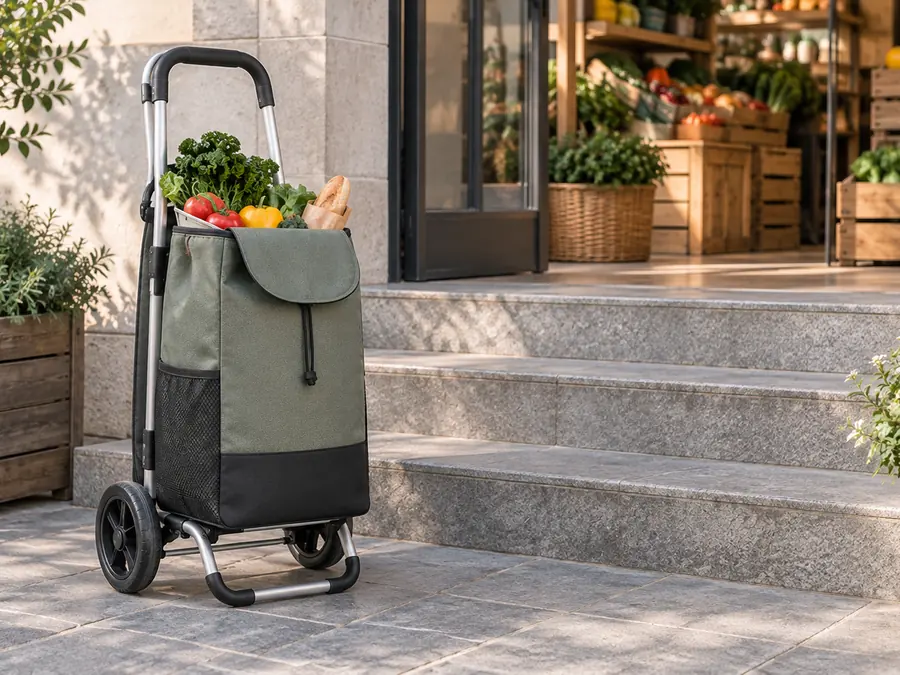
A folding shopping cart is a personal grocery cart: a collapsible frame on wheels that carries a fabric bag or a wire basket. Fabric trolley bags suit walking shoppers and fold slim for storage; wire grocery carts and folding utility carts carry bulkier loads. Compare frame material, wheel size and count, folded size, rated load, and whether the bag is removable or insulated.
"Shopping cart" covers a surprising range of products, from the steel trolleys a supermarket owns to the personal grocery cart a shopper folds into a hallway cupboard. This guide is about the second kind: the folding shopping cart, the foldable shopping cart with a fabric bag, the wire grocery cart and the folding utility cart. It compares the constructions, sets out what to check on a sample, and explains where an insulated trolley bag fits in a retail range.
A note on scope from the Eggroll Bags export desk: we supply fabric shopping trolley bags, including insulated versions. We do not make wire carts, metal utility carts or wagons, drawer and tiered storage carts, or store shopping carts. They are described here so you can plan a complete range.
What is a folding shopping cart?
A folding shopping cart is a personal cart on wheels that collapses for storage. It is a frame with a handle and two or more wheels, carrying either a fabric bag or a wire basket, built for walking shoppers who need to move a full load of groceries home.
Search terms overlap heavily. A grocery cart with wheels, a personal shopping cart, a portable grocery cart and a shopping trolley usually mean the same product, while "folding utility cart" and "collapsible cart" usually mean a flatbed or wagon-style cart for general hauling. Retail buyers should decide which job each SKU does, then name it consistently on the shelf and online.
Types of folding cart compared
There are five common constructions: the fabric trolley bag, the stair-climbing trolley, the wire folding grocery cart, the folding utility cart or wagon, and the insulated cooler trolley. They differ mostly in how they fold, how much they carry and how they handle kerbs and stairs.
| Type | How it folds | Strengths | Limits | Best for |
|---|---|---|---|---|
| Fabric trolley bag (two wheels) | Frame folds flat; bag collapses | Light, slim when folded, printable, bag can be removable | Moderate volume; fabric needs a solid base | Walking shoppers, markets, apartments |
| Stair-climbing trolley | As above | Wheel clusters step up kerbs and stairs | Heavier, more parts, higher cost | Shoppers with stairs or steep streets |
| Wire folding grocery cart | Basket folds flat on hinges | Large capacity, rigid, easy to load | Bulky, items can fall through without a liner | Bulk shops, laundry, longer walks |
| Folding utility cart / wagon | Frame collapses; fabric or plastic bed | Carries bulky and heavy items | Wide; awkward on narrow pavements and buses | Garden, beach gear, events |
| Insulated cooler trolley | Frame folds; insulated bag lifts off | Keeps chilled shopping cool, doubles as an outdoor cooler | Smaller usable volume because of the foam walls | Chilled and frozen shopping, picnics |
Tiered rolling carts and drawer rolling carts appear in the same searches, but they are storage furniture rather than shopping carts. Keep them in a separate range plan.
What to check in a foldable shopping cart with wheels
Wheels, frame, handle, bag attachment and folded size decide whether a foldable shopping cart works in daily use. Check them on the sample in that order, because the wheels and frame are the parts that fail first.
- Wheels. Larger wheels roll over kerbs, cobbles and cracks more easily than small ones. Check the wheel material, whether there are bearings, and how the axle is retained. Rattle and wobble on a new sample only get worse.
- Frame. Steel tube is strong and cheap but heavier; aluminium is lighter and more expensive. Look at the hinge and lock: the cart must lock open under load and not fold while being pulled.
- Handle. Height suits the shopper only if it is adjustable or set for the target market. A padded or moulded grip matters on a long walk.
- Bag attachment. A bag that clips or hooks on can be removed for cleaning or carried into a shop; a bag sewn to the frame cannot.
- Base. A fabric bag needs a stiffened base board, otherwise heavy items sag onto the wheels.
- Folded size and weight. Measure it folded. That is the size the shopper stores and the size the carton must fit.
- Rated load. Agree the load the cart is sold for, and test the sample loaded to that figure: pull it over a kerb, lift it, fold and unfold it.
Fabric and stitching checks follow the same logic as any bag. Our AQL quality control checklist sets out how to turn those points into inspection criteria. At pre-shipment inspection we work to ISO 2859-1 General Level II, AQL 2.5 major / 4.0 minor, and run handle pull (5 kg, 60 seconds), zip cycle and carton drop tests on site.
Insulated trolley bags: a grocery cart that keeps food cold
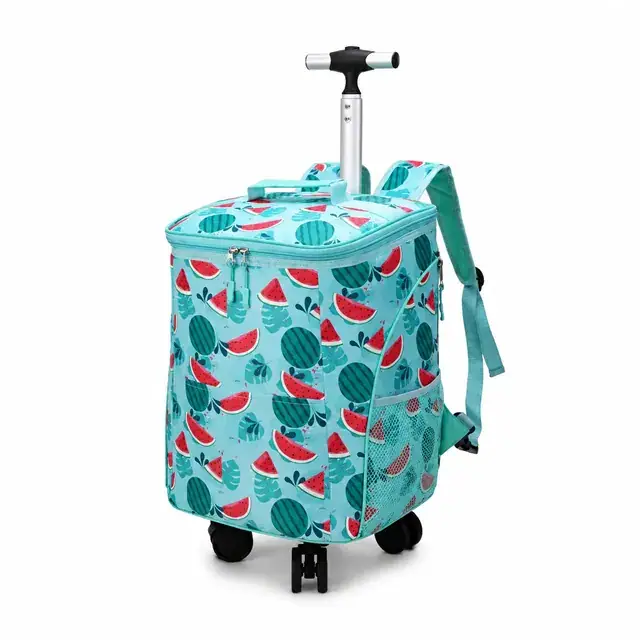
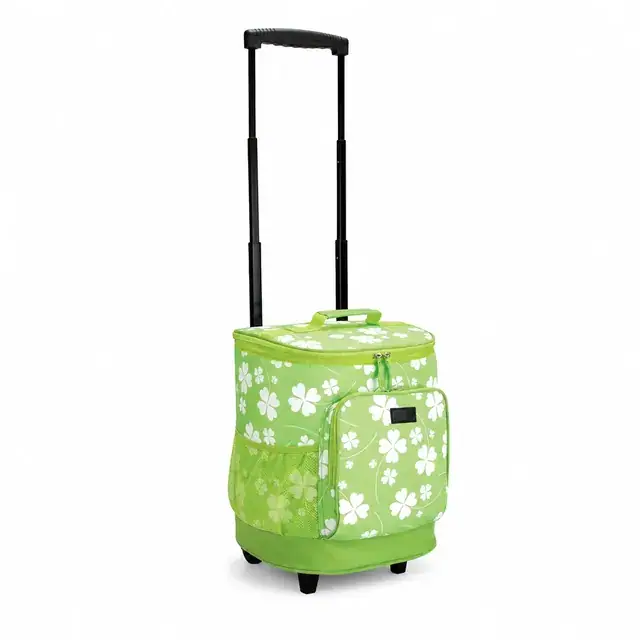
An insulated trolley bag combines a folding cart with wheels and a cooler bag, so chilled and frozen shopping stays cold on the walk home and the same product serves for picnics. It is the format we build.
Two tooled models in our shopping trolley range show the format:
- The portable wheeled market trolley bag: microfibre and 600D polyester, insulated, 30 × 24.5 × 40.5 cm.
- The insulated rolling cooler trolley bag: microfibre with a foil-lined interior, 30.5 × 28 × 34.5 cm.
Simple arithmetic gives the external volume of each at roughly 30 L; usable volume is lower once the insulated walls are taken out. Water weighs about 1 kg per litre, so a full bag of drinks and dense groceries can be a substantial load, which is exactly why it is on wheels rather than a shoulder.
On insulation, our published design data is that a 10 mm EPE foam wall with a welded leak-proof liner and two gel packs holds refrigerated food below 8 °C for roughly 6–8 hours at 25 °C ambient. A foil-lined trolley bag aimed at the grocery run will typically be lighter on foam, so match any claim to the construction and test it. Hold times are design ranges, never guarantees.
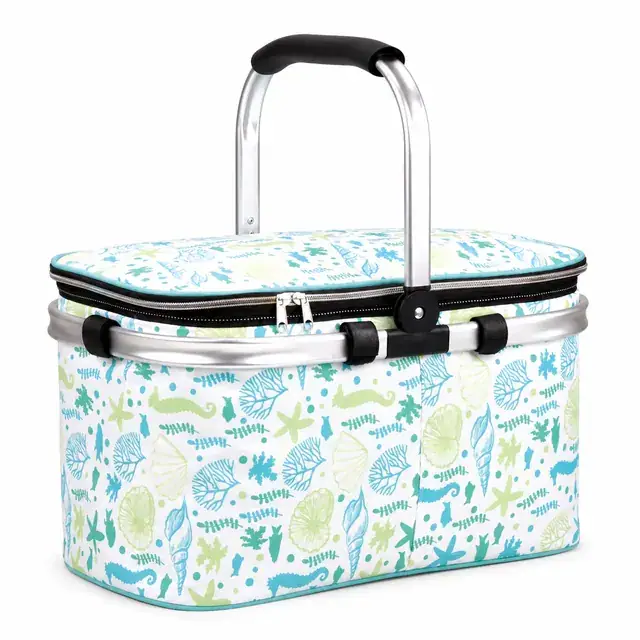
For shoppers who drive rather than walk, a collapsible cooler basket does a similar job without wheels; the folding insulated cooler basket is the catalogue example.
Designing a shopping trolley bag for your range
Start from a tooled frame and bag, then change the fabric, colour and print. That keeps pattern development out of the schedule and gets a sample to you faster.
The decisions that change cost and lead time most:
- Insulated or plain bag. Foam and liner add cost and reduce usable volume.
- Removable bag. Adds clips or hooks but lets the shopper clean the bag or carry it on its own.
- Fabric and colour. 600D polyester is the durable default; RPET 600D typically costs 8–15% more and needs a GRS transaction certificate to support a recycled-content claim. Catalogue colours start at 500 pcs per colour; a custom-dyed colour at 1,000 pcs.
- Decoration. Screen print, heat transfer, sublimation or full-surface printed fabric, plus woven labels or patches.
- Packaging. Folded in a polybag with a header card, or boxed; boxing adds cost and carton volume.
Shipping folding carts efficiently
A folding cart ships at its folded size, so a few centimetres of frame thickness change how many fit in a master carton and a container. Ask for folded dimensions, carton size and pieces per carton at quotation, not after sampling.
We quote EXW, FOB Shanghai or Ningbo, CIF or DDP. Sea freight to North Europe or the US East Coast takes 28–40 days. Our guide to shipping bags from Shanghai explains how each Incoterm splits cost and risk.
Ordering timeline for trolley bags
A counter sample takes 7–12 days, and the fee is credited against bulk. Bulk production runs 25–35 days after sample approval, with about a week extra from July to October. Payment is a 30% T/T deposit and 70% against a copy of the bill of lading, or L/C at sight above USD 30,000. When you know which trolley types your range needs, send us your brief and we will reply in writing within one working day.
Frequently asked
What is the best folding shopping cart for groceries?
For most walking shoppers, a two-wheel trolley with a fabric bag, a locking frame, large wheels and a stiffened base is the best balance of capacity, weight and storage. Choose a stair-climbing model for homes with steps, a wire cart for bulk shopping, and an insulated trolley bag when chilled food travels a distance.
What is the difference between a folding cart and a shopping trolley bag?
A shopping trolley bag is a type of folding cart: a narrow frame with two wheels carrying a fabric bag, designed for groceries. "Folding cart" also covers wire grocery carts and wider folding utility carts or wagons, which carry bulkier loads but take more space on pavements and when stored.
How much weight can a folding shopping cart carry?
It depends on the frame, wheels, axle and bag base, so there is no single answer. A rated load should be stated in the specification and tested on the sample: load the cart to that figure, pull it over kerbs, lift it and fold it. Do not print a load rating that has not been tested.
Can the bag on a trolley be removed and washed?
On designs where the bag clips or hooks onto the frame, yes, it lifts off for cleaning or carrying. Insulated trolley bags should be wiped clean rather than machine washed, because washing creases the foam and stresses the liner. Sewn-on bags cannot be removed, so specify a removable bag if it matters.
Do you supply wire grocery carts or folding utility carts?
No. Our trolley range is fabric trolley bags, including insulated versions, plus related cooler baskets. Wire carts, utility carts and wagons, tiered or drawer rolling carts and store shopping carts are outside our catalogue. For fabric trolley bags, send a brief and we will match it to a tooled model.