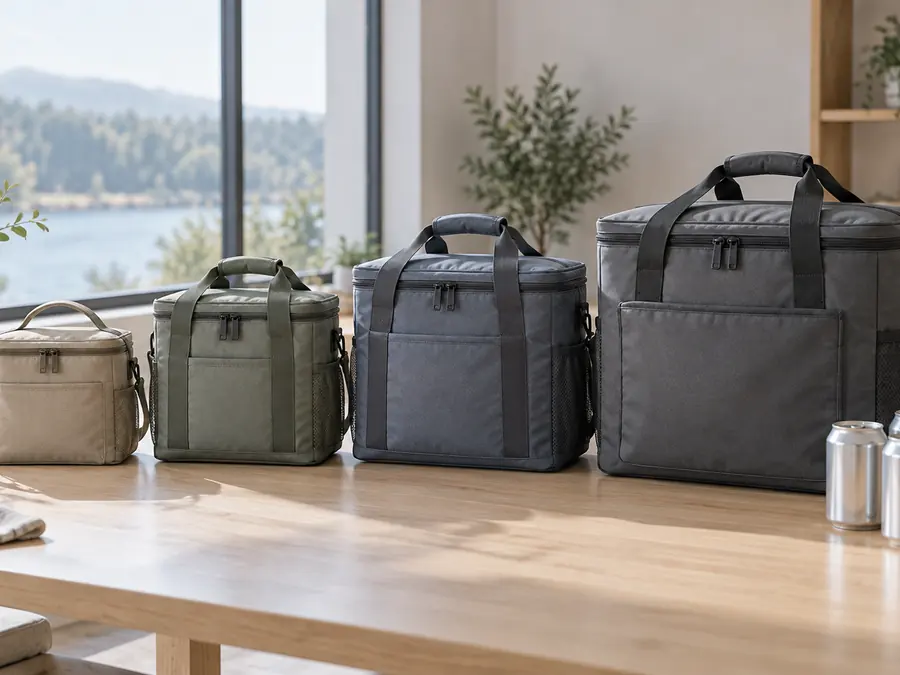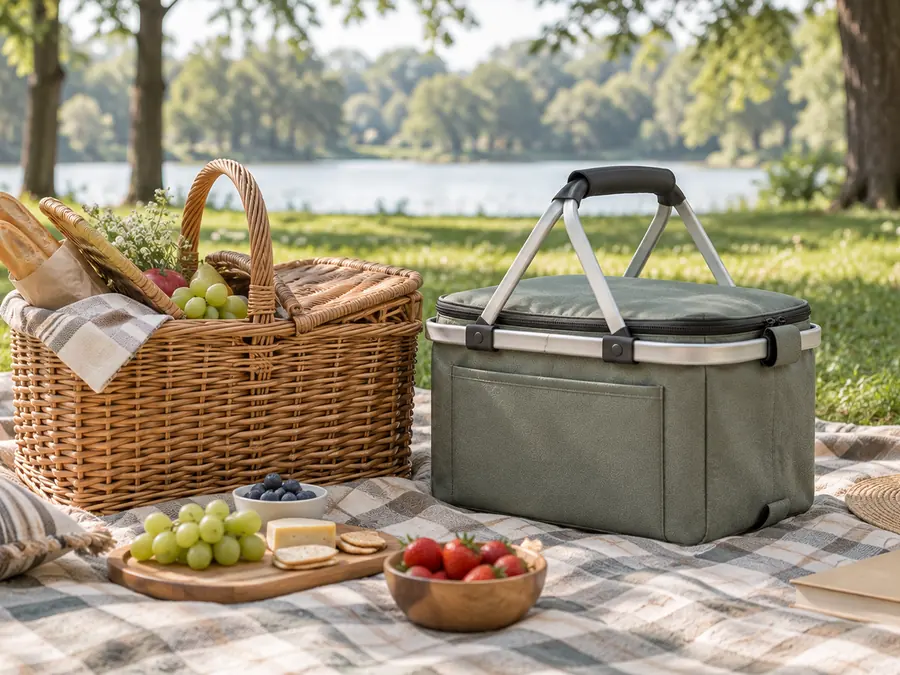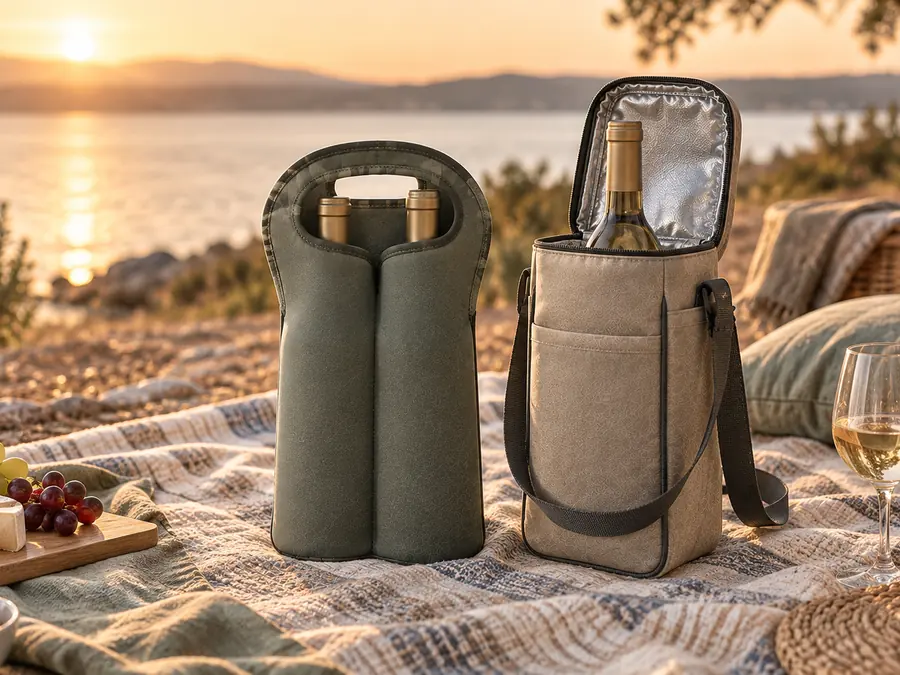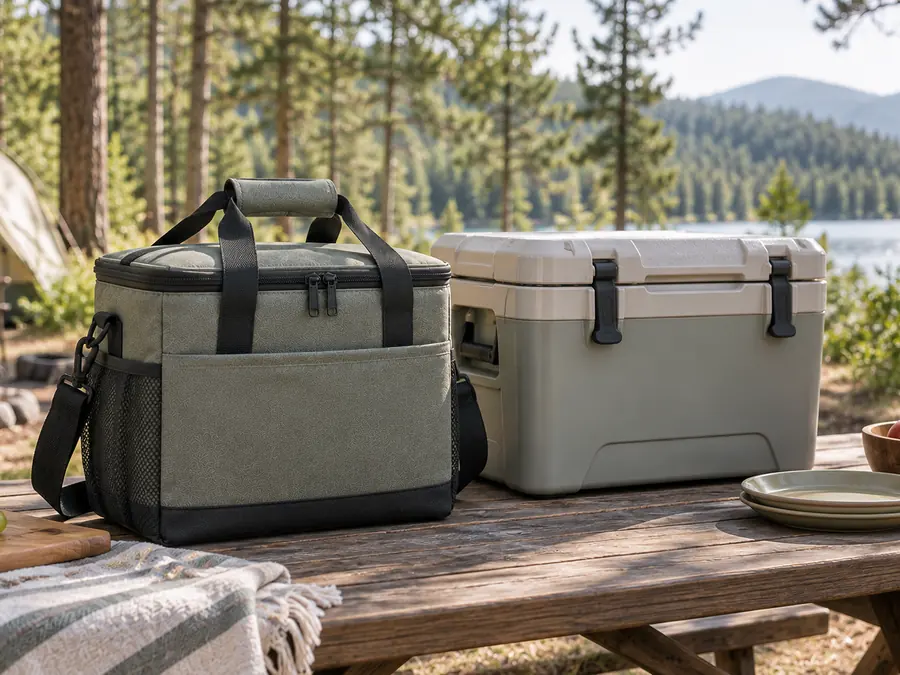
A hard cooler is a moulded plastic shell filled with foam: it holds ice longest and takes abuse, but it is heavy, bulky and expensive to ship. A soft sided cooler is a sewn fabric shell with closed-cell foam and a liner: lighter, cheaper, easy to store and decorate, and sold in hours of cold hold rather than days. Most ranges need both roles covered.
Buyers planning a seasonal cooler range usually start with the question their shoppers type into a search bar: soft cooler or hard cooler? The honest answer is that the two do different jobs, sell at different price points and produce very different freight bills. This guide compares soft cooler vs hard cooler from the retailer's side of the shelf, then goes deeper into the soft sided cooler, which is the half of the category we build.
One disclosure up front. The Eggroll Bags export desk supplies soft coolers, cooler backpacks, cooler baskets, wheeled cooler trolleys and 12 V car cooler bags. We do not make hard-shell coolers. Where this guide describes hard coolers, it is so you can plan a balanced range, not because we are selling one.
Soft cooler vs hard cooler: the short comparison
A hard cooler wins on ice retention and abuse resistance; a soft cooler wins on weight, storage, decoration, price and freight. Everything else follows from how each one is built.
A hard cooler is a moulded polyethylene shell (injection-moulded at the budget end, rotomoulded at the premium end) with polyurethane foam in the walls and a gasketed lid. A soft cooler is a sewn fabric shell, a sheet of closed-cell EPE foam and a liner, closed with a zip, flap or roll-top.
| Factor | Hard cooler | Soft sided cooler |
|---|---|---|
| Construction | Moulded PE shell, PU foam, gasketed lid | Fabric outer, EPE foam, PEVA, TPU or PVC liner |
| Typical cold hold | Usually quoted in days with ice, depending on wall thickness | Quoted in hours: roughly 6–8 h for a 10 mm wall with two gel packs at 25 °C, longer with 15–20 mm walls |
| Empty weight | Heavy; large models become a two-person lift when full | Light; a fraction of a hard cooler of similar capacity |
| Storage when empty | Same footprint as when full | Many fold flat or compress |
| Freight | Ships at full volume, few per carton | Folds or nests, many per carton |
| Decoration | Moulded colour, stickers, pad print | Screen print, heat transfer, sublimation, embroidery, woven labels, patches |
| Price position | Mid to premium | Promotional through upper-mid retail |
| Natural use | Multi-day camping, boats, job sites | Lunch, picnic, beach, car, day trips, grocery runs |
For a range planner, the freight row matters as much as performance: a folding soft cooler puts far more units in a carton, which is why soft coolers fill most "coolers on sale" end caps.
Which is the best cooler for your customers?
The best cooler is the one insulated for how long the food actually needs to stay cold. For most shoppers that is a working day or a day out, not a week, and a soft cooler covers it at a lower price and weight.
- Office lunch and school — a soft lunch cooler with 8–10 mm foam and a wipe-clean liner.
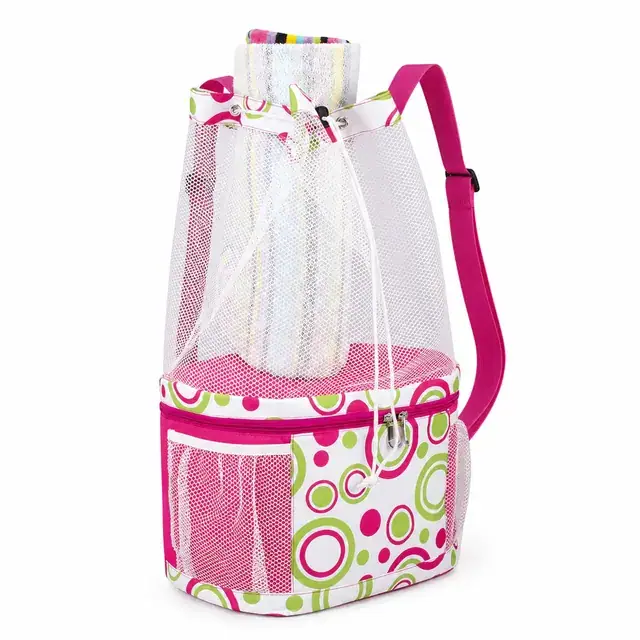
- Picnic, park and beach — a soft cooler tote, basket or cooler backpack with a 10 mm wall and a welded liner.
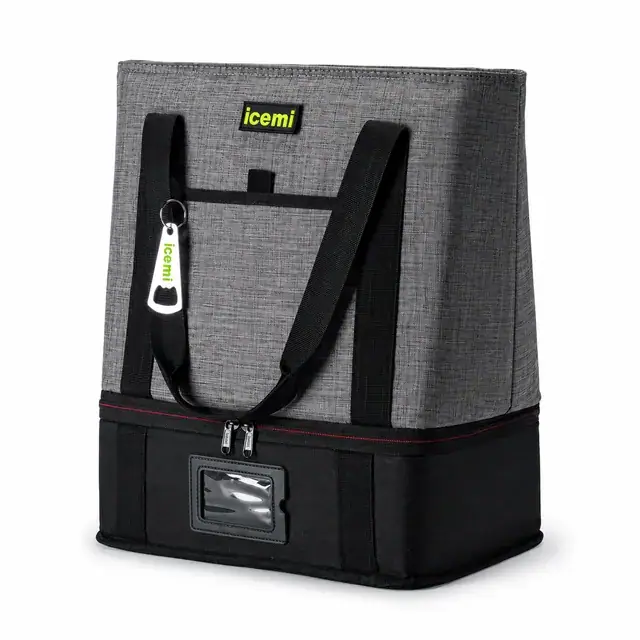
- Day fishing and sports sidelines — a larger soft sided cooler with a heavy 1680D outer and a 15 mm wall.
- Road trips — a passive soft cooler sized for the footwell, or a powered car cooler bag for longer drives.
- Multi-day camping with no resupply — genuinely hard cooler territory.
"Best coolers for camping" searches often default to hard coolers, yet much camping is one night beside the car, which a full 15–20 mm soft cooler kept in the shade covers. "Best cooler for the money" really means a product that delivers what its label promises.
What makes the best soft cooler?
Four decisions decide soft cooler performance, in this order: foam thickness, liner construction, closure and outer fabric.
- Foam thickness. Closed-cell EPE foam is the insulation in almost every soft cooler. Our published design data: a 10 mm EPE wall with a welded leak-proof liner and two gel packs holds refrigerated food below 8 °C for roughly 6–8 hours at 25 °C ambient. Thicker 15–20 mm walls extend that range, at the cost of carton volume.
- Welded liner. A high-frequency welded PEVA or TPU liner holds melt water and wipes clean. A stitched liner has needle holes, and every hole is a leak path.
- Closure. Heat gets in through the opening more than through the walls. A zip with an insulated storm flap or a roll-top outperforms a plain zip; a hook-and-loop flap performs worst.
- Outer fabric and colour. 600D polyester is the workhorse; 1680D adds abrasion resistance for outdoor use. A light outer colour absorbs less sun than a dark one.
The detail behind each of these, including liner chemistry and cost trade-offs, is in our cooler bag insulation guide.
Large coolers and coolers with wheels: when should you add wheels?
Add wheels once a full cooler is too heavy to carry comfortably. Water weighs about 1 kg per litre, so a 30 L cooler packed with drinks and ice can approach 20 kg, and at that point a shoulder strap stops being a selling point.
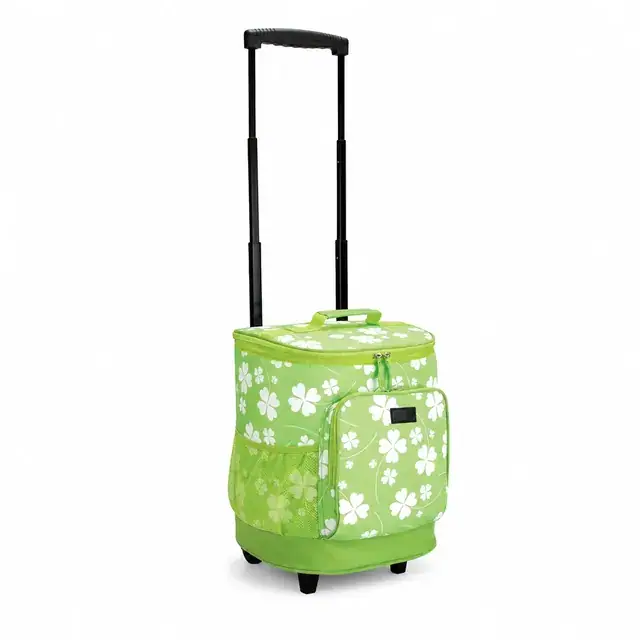
Most retail ranges therefore step up like this: a lunch cooler, a 10–20 L day cooler, a large cooler bag of 25–40 L, and then a rolling cooler for shoppers who will move heavy loads. A large cooler with wheels in the soft category is usually a trolley construction: an insulated bag on a frame with a telescopic handle, rather than wheels moulded into a shell.
When a buyer asks "should I get a wheel cooler?" on behalf of their customers, the useful checks are:
- Wheel width and diameter. Narrow, small wheels sink in soft sand. A beach cooler with wheels needs wider wheels than a car-park model.
- Handle lock. The telescopic handle should lock at its working height and fold away fully.
- Base protection. A skid strip or feet under the bag stop the fabric wearing where it touches the ground.
Our insulated rolling cooler trolley bag (30.5 × 28 × 34.5 cm, foil-lined) is the catalogue starting point for a cooler with wheels and handle. For carried large coolers, the 1680D outdoor cooler bag (33 × 21 × 40 cm) and the thermal insulation picnic backpack (53 × 22 × 51 cm) cover the 25 L-plus end of the range.
Colour is a range decision too. A pink cooler with wheels or any other fashion shade is a Pantone lab dip: catalogue colours start at 500 pcs per colour, while a custom-dyed colour needs 1,000 pcs per colour.
Car coolers: passive soft cooler or 12 V cooler bag?
For trips under a day, a passive soft cooler is enough. For longer drives where the vehicle has a 12 V socket, a powered car cooler bag keeps chilled food cool without relying only on gel packs.
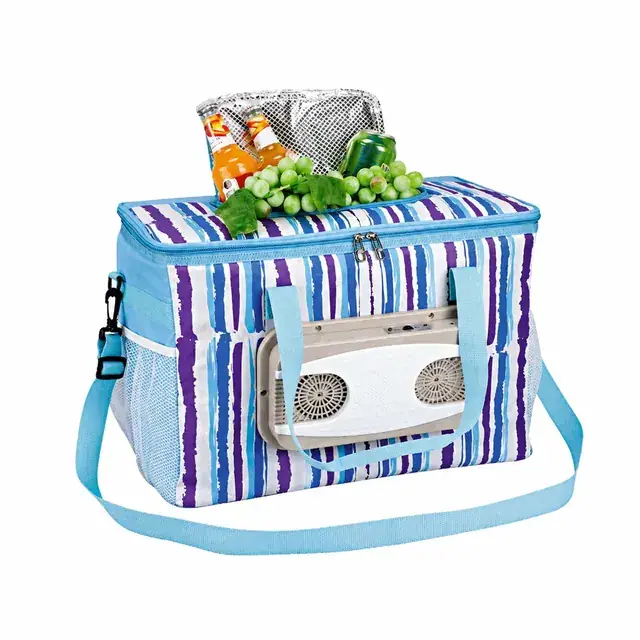
A car cooler has to fit its footwell or seat, so work backwards from that space. Our electric car cooler bag measures 47 × 28 × 32 cm, an external volume of about 42 L by simple arithmetic; usable space is lower once the insulated walls are subtracted. A smaller 10 L version suits drinks and a few meals.
Powered products carry extra electrical compliance requirements in most markets; confirm them with your own compliance team before listing.
Floating coolers and other claims worth checking
Closed-cell foam is buoyant, so many soft coolers float when empty or lightly loaded. A "floating cooler" claim implies it floats when loaded, which is a different statement. Test it in water with a realistic load before the word goes on the packaging.
The same discipline applies to "leak-proof" (which needs a welded liner and a leak test; ours is 1 L of water for 10 minutes) and to any hold-time number. We will run a timed temperature test on an approved sample on request, and the claim you print should be the one that log supports. Hold times are design ranges, never guarantees.
How to plan a soft cooler range for retail
Plan by price tier and use, fix the claim each tier can support, then pick tooled models to shorten development. This sequence works for a first range:
- Map the tiers. Entry (lunch cooler), core (day cooler or basket), hero (large, backpack or wheeled).
- Fix the cold-hold claim per tier and the foam thickness, liner and closure that support it.
- Shortlist tooled catalogue models so no tier needs a new pattern.
- Set the colour plan. Stock colours at 500 pcs per colour, custom-dyed at 1,000 pcs.
- Order counter samples. They take 7–12 days, and the fee is credited against bulk. Run the timed temperature test on the approved sample.
- Agree compliance. REACH, Prop 65 and food-contact migration on the liner, issued per model and market in your name.
- Book production against the season. Bulk takes 25–35 days after sample approval, July–October adds about a week, and sea freight to North Europe or the US East Coast is 28–40 days.
Where a soft cooler supplier fits
If your range needs hard coolers, buy them from a moulding specialist. For everything soft — lunch, tote, basket, backpack, trolley and car — we hold 154 tooled cooler and insulated models in the cooler and insulated bag range, with inline checks at 20% and 80% of production and pre-shipment inspection to AQL 2.5 major / 4.0 minor. Send us your tiers and target claims and we will reply in writing within one working day with matching models.
Frequently asked
Is a soft cooler or a hard cooler better?
Neither is better in general. A hard cooler holds ice for longer and survives rough handling, which suits multi-day trips. A soft cooler is lighter, cheaper, easier to store and to decorate, and holds cold for hours, which suits lunch, picnics, beach days and car journeys. Most shoppers' trips fit the soft cooler's range.
How long does a soft sided cooler keep things cold?
It depends on the construction. Our design data shows a 10 mm EPE foam wall with a welded liner and two gel packs keeps refrigerated food below 8 °C for roughly 6–8 hours at 25 °C. A 15–20 mm wall, a storm flap over the zip and a light outer colour extend that. These are design ranges, not guarantees.
Should I get a cooler with wheels?
Choose wheels when the cooler will be heavy when full. Water weighs about 1 kg per litre, so a packed 30 L cooler can approach 20 kg. For beach use, look for wider wheels that do not sink in sand, a locking telescopic handle and a protected base. For carried day coolers, a padded strap is usually enough.
What counts as a large cooler?
There is no fixed definition, but retail ranges usually treat about 25–40 L as large in soft coolers. Above that, a full soft cooler gets heavy enough that wheels make sense. Check internal volume, not just external dimensions, because the insulated walls take up space on every side.
Are soft coolers cheaper than hard coolers?
Generally yes, both to make and to ship. Soft coolers use sewn fabric, sheet foam and film rather than a moulded shell, and many fold flat, so more units fit in each carton. That is why soft coolers fill most entry-price and promotional slots, while hard coolers sit at mid to premium prices.